Social Media Data Analytics: A Complete Guide to Understanding Social Media Data in 2026
Social media has completely changed the way businesses communicate with their customers. Platforms such as Instagram, Facebook, YouTube, LinkedIn, TikTok, and X are no longer used only for entertainment and communication. They have become powerful marketing channels where businesses can build brands, attract customers, generate leads, promote products, and increase sales.
However, simply creating social media posts is not enough to achieve marketing success. A business may publish hundreds of posts, but without knowing how people respond to that content, it becomes difficult to understand whether the strategy is actually working.
This is where social media data analytics becomes important.
Social media data analytics helps businesses collect, measure, analyze, and interpret information generated from their social media activities. It allows marketers to understand audience behavior, measure content performance, identify trends, improve advertising campaigns, and make better marketing decisions.
Instead of asking, “Did our post perform well?”, marketers can use data to answer more useful questions such as:
- How many people saw the content?
- Who interacted with it?
- Which content generated the most engagement?
- Which platform generated the most website traffic?
- Which audience converted into customers?
- How much did the campaign cost?
- What type of content should we create next?
In this complete guide, we will explore what social media data analytics means, why it is important, different types of social media data, important metrics, tools, benefits, challenges, practical examples, and the future of social media analytics.
What Is Social Media Data Analytics?
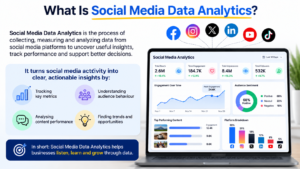
Social media data analytics is the process of collecting, measuring, organizing, analyzing, and interpreting data from social media platforms to understand audience behavior and improve marketing performance.
Every activity on social media can generate data.
For example, when a user:
- Likes a post
- Comments on a video
- Shares a Reel
- Saves an image
- Clicks a link
- Watches a video
- Follows an account
- Sends a direct message
- Purchases a product
these actions can provide valuable information to marketers.
Social media analytics converts these individual actions into meaningful insights.
For example, imagine a clothing brand publishes two Instagram Reels.
The first Reel receives:
- 50,000 views
- 3,000 likes
- 500 shares
- 400 saves
- 150 website clicks
The second Reel receives:
- 5,000 views
- 300 likes
- 20 shares
- 10 saves
- 15 website clicks
The business can compare these results and identify which type of content is more effective.
The important point is that analytics does not simply tell a marketer what happened. It helps explain why something happened and what should happen next.
Why Is Social Media Data Analytics Important?
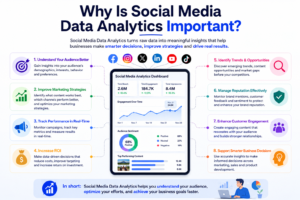
Social media marketing produces a large amount of information every day. Without analytics, businesses may struggle to understand which activities are generating meaningful results.
There are several reasons why social media data analytics is important.
1. Helps Understand the Target Audience
One of the biggest advantages of social media analytics is understanding who your audience is.
Analytics can provide information about:
- Age
- Gender
- Location
- Language
- Interests
- Device usage
- Online activity
- Content preferences
For example, a business may discover that its most engaged audience consists of young adults between 18 and 30.
Based on this information, the business can create content that is more relevant to that group.
Understanding your audience allows you to move from general marketing to more targeted marketing.
2. Measures Content Performance
Not every post performs equally.
Some posts may receive thousands of views, while others may receive very little attention.
Social media analytics helps marketers identify the content that performs best.
For example, analytics can reveal that:
- Reels receive more reach than images.
- Educational posts receive more saves.
- Customer testimonials generate more comments.
- Product demonstrations generate more clicks.
- Behind-the-scenes videos generate more engagement.
This information helps businesses create more effective content.
3. Supports Data-Driven Decision Making
Without analytics, marketers may make decisions based on personal opinions.
For example:
“I think our audience likes these posts.”
Analytics can replace assumptions with evidence:
“Our last 10 educational videos generated 40% more engagement than promotional posts.”
This is the difference between guesswork and data-driven marketing.
4. Improves Advertising Performance
Businesses spend significant amounts of money on social media advertising.
Analytics helps marketers understand whether advertising budgets are being used effectively.
Marketers can analyze:
- Impressions
- Clicks
- Cost per click
- Conversion rate
- Cost per conversion
- Revenue
- Return on ad spend
If one advertisement is generating better results than another, the marketer can increase its budget and reduce spending on poor-performing advertisements.
5. Helps Increase Sales
Social media analytics can connect marketing activities with business results.
For example:
Instagram Ad → Website Visit → Product Page → Add to Cart → Purchase
By analyzing this journey, marketers can identify where customers are converting and where they are dropping out.
This makes it easier to optimize the customer journey.
Types of Social Media Data
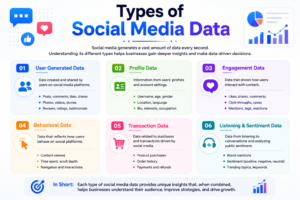
There are several different types of social media data businesses can analyze.
1. Demographic Data
Demographic data tells you who your audience is.
It may include:
- Age
- Gender
- Location
- Language
- Occupation
- Education
For example, an online fashion store may discover that most of its customers are young adults living in major cities.
This information can help the business improve its targeting.
2. Engagement Data
Engagement data shows how users interact with your content.
Common engagement actions include:
- Likes
- Comments
- Shares
- Saves
- Reactions
- Replies
- Mentions
Engagement is important because it indicates that people are actively interacting with your content.
However, marketers should not assume that likes are the only important form of engagement.
A post with fewer likes but many shares and website clicks may actually produce better business results.
3. Reach Data
Reach refers to the number of unique users who see your content.
For example, if 20,000 different users see an Instagram post, the post has a reach of 20,000.
Reach is particularly useful when measuring brand awareness.
4. Impression Data
Impressions represent the total number of times your content is displayed.
One person can generate multiple impressions.
For example:
A post reaches 10,000 people but receives 15,000 impressions.
This means some users saw the content more than once.
Reach and impressions are therefore different metrics.
5. Traffic Data
Social media can drive traffic to websites, blogs, landing pages, and online stores.
Traffic data helps marketers understand:
- Which platform sends the most visitors
- Which posts generate clicks
- Which campaigns generate website traffic
- What visitors do after arriving
- Whether visitors convert
This is especially important for businesses that depend on websites for sales or lead generation.
6. Conversion Data
Conversion data measures whether users complete a desired action.
Conversions can include:
- Purchasing a product
- Signing up for a newsletter
- Filling out a form
- Downloading an app
- Booking a service
- Requesting information
Conversion data is extremely important because it connects social media activity with business objectives.
Important Social Media Analytics Metrics
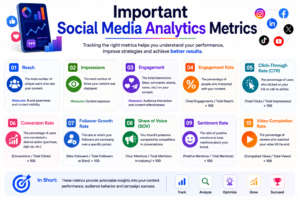
Understanding social media metrics is essential for digital marketers.
1. Reach
Reach measures the number of unique users exposed to your content.
For example:
Reach = 30,000
This means approximately 30,000 unique accounts saw the content.
Reach is useful for measuring awareness and visibility.
2. Impressions
Impressions measure how many times your content was displayed.
For example:
Reach = 10,000
Impressions = 17,000
This indicates that the content was displayed 17,000 times to 10,000 unique users.
3. Engagement Rate
Engagement rate measures how actively users interact with content.
A simplified formula is:
Engagement Rate = Total Engagements ÷ Reach × 100
For example, if a post reaches 20,000 users and receives 1,000 engagements:
1,000 ÷ 20,000 × 100 = 5%
A higher engagement rate can indicate stronger audience interest.
4. Click-Through Rate
Click-through rate, commonly called CTR, measures the percentage of people who click on a link after seeing content or an advertisement.
Formula:
CTR = Clicks ÷ Impressions × 100
For example:
20,000 impressions and 600 clicks.
CTR:
600 ÷ 20,000 × 100 = 3%
5. Conversion Rate
Conversion rate measures how many users complete a desired action.
Formula:
Conversion Rate = Conversions ÷ Total Visitors × 100
For example:
1,000 visitors and 50 purchases.
Conversion rate:
50 ÷ 1,000 × 100 = 5%
6. Follower Growth Rate
Follower growth rate measures how quickly an account is gaining followers.
It can help businesses identify whether their audience is growing over time.
However, follower count should not be treated as the only measure of success.
A smaller account with highly engaged customers can be more valuable than an account with millions of inactive followers.
7. Video Views
Video views are important for platforms such as YouTube, Instagram, and TikTok.
Marketers can analyze:
- Views
- Watch time
- Average view duration
- Completion rate
- Audience retention
- Replays
These metrics help determine whether video content is attracting and retaining attention.
8. Cost Per Click
Cost per click, or CPC, measures how much an advertiser pays for each click.
Formula:
CPC = Total Advertising Cost ÷ Number of Clicks
For example:
Advertising cost = ₹10,000
Clicks = 2,000
CPC = ₹5
The advertiser paid an average of ₹5 per click.
9. Cost Per Acquisition
Cost per acquisition, or CPA, measures the average cost of generating a conversion or acquiring a customer.
Formula:
CPA = Total Campaign Cost ÷ Number of Acquisitions
For example:
Campaign cost = ₹20,000
Customers acquired = 100
CPA = ₹200
This means the business spent an average of ₹200 to acquire each customer.
10. Return on Ad Spend
ROAS measures the revenue generated from advertising compared with the advertising cost.
Formula:
ROAS = Revenue Generated ÷ Advertising Cost
For example:
Advertising cost = ₹25,000
Revenue = ₹100,000
ROAS = 4
This means the campaign generated ₹4 in revenue for every ₹1 spent on advertising.
Social Media Sentiment Analysis
Sentiment analysis is another important part of social media data analytics.
Sentiment analysis examines online conversations and identifies whether opinions are:
- Positive
- Negative
- Neutral
For example, imagine a smartphone company launches a new product.
Customers may comment:
“The camera quality is excellent.”
“The battery is amazing.”
“The phone is too expensive.”
“The design looks great.”
Analytics tools can analyze these conversations and identify overall customer sentiment.
This can help businesses understand:
- Customer satisfaction
- Brand reputation
- Product opinions
- Customer complaints
- Campaign reactions
Sentiment analysis is especially useful for reputation management.
Social Listening and Social Media Analytics
Social listening involves monitoring online conversations about a brand, product, industry, competitor, or topic.
For example, a company may monitor mentions of its brand across social media.
It can discover:
- What customers are saying
- What problems customers experience
- What products customers want
- What trends are becoming popular
- What competitors are doing
Social listening allows businesses to respond to conversations rather than simply publishing content.
Social Media Competitor Analysis
Businesses should not analyze only their own social media accounts.
Analyzing competitors can provide valuable insights.
Competitor analytics may examine:
- Posting frequency
- Content formats
- Engagement
- Audience reactions
- Popular topics
- Campaigns
- Video strategy
For example, suppose three competitors are receiving strong engagement from educational videos.
This may indicate that educational content is popular within that industry.
However, competitor analysis should not mean copying competitors.
Instead, marketers should identify opportunities to create something better or different.
Social Media Analytics for Different Platforms
Different platforms provide different types of information.
Instagram Analytics
Instagram is highly visual and is widely used for:
- Reels
- Stories
- Images
- Carousels
- Live videos
Important analytics include:
- Reach
- Views
- Engagement
- Saves
- Shares
- Profile visits
- Website clicks
- Audience demographics
For brands using Instagram heavily, Reel performance and audience interaction can provide valuable insights.
Facebook Analytics
Facebook can provide information about:
- Page performance
- Post engagement
- Reach
- Video performance
- Audience demographics
- Advertising campaigns
- Link clicks
Businesses can use these insights to improve organic and paid content.
YouTube Analytics
YouTube provides detailed video analytics.
Important metrics include:
- Views
- Watch time
- Average view duration
- Audience retention
- Subscribers
- Traffic sources
- Click-through rate
For video marketers, audience retention is particularly useful because it can show where viewers stop watching.
LinkedIn Analytics
LinkedIn is particularly useful for professional and B2B marketing.
Marketers can analyze:
- Impressions
- Engagement
- Followers
- Audience demographics
- Website traffic
- Leads
- Post performance
Businesses can use this data to improve professional content and lead generation.
TikTok Analytics
TikTok analytics can provide information about:
- Video views
- Engagement
- Watch time
- Audience demographics
- Traffic sources
- Follower activity
Because short-form video is central to TikTok, understanding video retention and engagement can help creators improve their content.
Social Media Data Analytics Tools
Businesses can use different tools to analyze social media data.
1. Native Analytics Tools
Social platforms provide their own analytics dashboards.
These tools are useful because they provide direct information about account and content performance.
2. Google Analytics
Google Analytics can help marketers understand what happens after users leave social media.
For example:
Social Media → Website → Product Page → Checkout → Purchase
This helps businesses understand the full customer journey.
3. Social Media Management Tools
Businesses managing multiple platforms can use social media management tools to organize analytics in one place.
These platforms may provide:
- Scheduling
- Reporting
- Monitoring
- Engagement management
- Performance comparisons
- Social listening
4. Spreadsheets
Small businesses and beginners can use spreadsheets to track important metrics.
For example:
Metric | January | February | March |
Followers | 5,000 | 5,800 | 6,700 |
Reach | 40,000 | 48,000 | 60,000 |
Engagement | 2,500 | 3,200 | 4,600 |
Website Clicks | 600 | 850 | 1,200 |
Leads | 50 | 75 | 110 |
This simple reporting system can help marketers identify growth and performance trends.
How to Perform Social Media Data Analytics
A successful analytics process should follow several steps.
Step 1: Define Your Goals
Start by deciding what you want to achieve.
Your goal could be:
- Increase brand awareness
- Generate leads
- Increase sales
- Improve engagement
- Increase website traffic
- Grow your audience
Your goals determine which metrics you should track.
Step 2: Choose Your KPIs
KPIs, or Key Performance Indicators, are the metrics used to measure progress toward your goals.
For brand awareness, track:
- Reach
- Impressions
- Views
- Follower growth
For lead generation, track:
- Clicks
- Landing page visits
- Leads
- Conversion rate
- Cost per lead
For sales, track:
- Purchases
- Revenue
- Conversion rate
- CPA
- ROAS
Step 3: Collect Data
Collect data from:
- Social media platforms
- Advertising platforms
- Website analytics
- CRM systems
- Social listening tools
Make sure data is collected consistently.
Step 4: Organize the Data
Organize your information into categories such as:
- Platform
- Campaign
- Content type
- Date
- Audience
- Location
- Objective
This makes analysis easier.
Step 5: Identify Trends
Look for patterns.
Ask questions such as:
- Which posts perform best?
- Which videos generate the most views?
- Which content receives the most shares?
- Which platform produces the most website traffic?
- Which audience converts better?
- Which campaigns produce the highest revenue?
Step 6: Compare Results
Compare your results with:
- Previous months
- Previous campaigns
- Marketing goals
- Industry benchmarks
- Competitors
Comparisons help you understand whether performance is improving.
Step 7: Take Action
Analytics should lead to action.
Suppose your data shows that short educational videos receive much higher engagement than promotional posts.
You could increase educational video production.
If a particular advertisement produces more conversions, you could allocate more budget to that campaign.
Step 8: Test and Improve
Social media marketing requires continuous testing.
You can test:
- Headlines
- Captions
- Images
- Videos
- Hooks
- Calls to action
- Posting times
- Audiences
After testing, use analytics to identify which version performs better.
Benefits of Social Media Data Analytics
Social media analytics provides many benefits to businesses.
Better Decision-Making
Businesses can make decisions based on evidence rather than assumptions.
Better Content
Analytics helps marketers understand what audiences actually enjoy.
Improved Audience Targeting
Businesses can identify valuable audience segments.
Higher Engagement
Understanding audience preferences can improve engagement.
Better Advertising
Analytics helps optimize advertising budgets.
More Leads
Businesses can identify campaigns that generate high-quality leads.
More Sales
Conversion tracking can help businesses improve their sales process.
Better Customer Relationships
Social listening can help brands understand customer concerns and expectations.
Competitive Advantage
Companies that use data effectively can respond faster to market changes.
Common Social Media Analytics Mistakes
1. Focusing Only on Followers
Having thousands of followers does not guarantee success.
Engagement, traffic, leads, and conversions may be more important.
2. Tracking Too Many Metrics
Too much data can create confusion.
Instead, focus on metrics directly connected to your goals.
3. Ignoring Conversions
Likes and comments are useful, but businesses also need to understand whether social media produces actual business results.
4. Looking at Individual Posts Only
One post does not always represent your overall strategy.
Analyze trends across multiple posts and longer periods.
5. Ignoring Negative Feedback
Negative comments can provide valuable information about customer problems.
Instead of ignoring criticism, businesses can analyze it and identify opportunities for improvement.
6. Making Decisions Too Quickly
A single viral post does not necessarily mean that your strategy is successful.
Look for consistent patterns.
Role of Artificial Intelligence in Social Media Analytics
Artificial intelligence is changing the way businesses analyze social media data.
AI can process large quantities of information quickly.
It can help marketers with:
- Sentiment analysis
- Trend identification
- Audience segmentation
- Content recommendations
- Automated reporting
- Predictive analytics
- Social listening
- Customer behavior analysis
For example, imagine a brand receives 50,000 social media comments.
Reading every comment manually could take a significant amount of time.
An AI-powered system can categorize comments into topics such as:
- Product quality
- Price
- Customer service
- Delivery
- Product requests
- Complaints
This allows marketers to identify major issues much faster.
However, AI should support human decision-making rather than completely replace it.
Human marketers still need to understand brand goals, customer psychology, business objectives, and market conditions.
Privacy and Ethical Considerations
Social media analytics must be used responsibly.
Businesses collect and analyze large amounts of customer-related information, so privacy and security are important.
Businesses should consider:
- Protecting personal information
- Following applicable privacy laws
- Following platform policies
- Being transparent about data usage
- Securing customer information
- Avoiding unfair targeting
- Using customer information responsibly
Good analytics is not only about collecting as much data as possible.
It is about collecting and using useful information responsibly.
Practical Example of Social Media Data Analytics
Consider a small fitness brand that uses Instagram to promote its products.
During one month, the brand publishes:
- 10 Reels
- 8 image posts
- 20 Stories
At the end of the month, the marketing team analyzes the results.
They discover:
Reels
Average reach: 15,000
Engagement: High
Website clicks: High
Image Posts
Average reach: 4,000
Engagement: Medium
Website clicks: Low
Stories
Average reach: 2,500
Direct replies: High
Product inquiries: High
The data provides several insights.
The brand can decide to:
- Create more Reels.
- Use Stories for customer interaction.
- Reduce low-performing image posts.
- Improve calls to action.
- Test different video topics.
- Track conversions.
- Retarget interested users.
This demonstrates an important principle:
The purpose of analytics is not simply to collect numbers. The purpose is to turn data into better decisions.
How Social Media Analytics Supports the Customer Journey
Social media analytics can help businesses understand different stages of the customer journey.
Awareness
Customers first discover a brand.
Important metrics include:
- Reach
- Impressions
- Video views
Consideration
Customers begin researching the brand.
Important metrics include:
- Website clicks
- Profile visits
- Saves
- Comments
- Product page visits
Conversion
Customers take an action.
Important metrics include:
- Leads
- Purchases
- Signups
- Conversion rate
- CPA
Retention
Customers continue interacting with the business.
Important indicators include:
- Repeat purchases
- Customer engagement
- Messages
- Reviews
- Mentions
This makes social media analytics useful beyond simple content performance.
Future of Social Media Data Analytics
The future of social media analytics is likely to become increasingly connected with artificial intelligence, automation, and predictive technologies.
Businesses will increasingly use data to understand not only what happened in the past but also what might happen in the future.
Future analytics may focus more heavily on:
- Predictive customer behavior
- AI-powered recommendations
- Real-time analytics
- Automated reporting
- Advanced audience segmentation
- Cross-platform data
- Social listening
- Customer journey analysis
Instead of simply saying:
“Last month’s campaign performed well.”
Advanced analytics can help marketers ask:
“What type of campaign is most likely to perform well with this audience next month?”
This shift from descriptive analytics to predictive analytics can make marketing strategies more efficient.
Best Practices for Social Media Data Analytics
To use social media analytics effectively, businesses should follow several best practices.
Set Clear Objectives
Always define what you want to achieve before measuring data.
Track Relevant Metrics
Do not track metrics simply because they are available.
Track metrics that support your objectives.
Analyze Data Regularly
Create weekly or monthly reports to identify changes.
Compare Performance
Compare campaigns, content types, platforms, and time periods.
Combine Quantitative and Qualitative Data
Numbers tell you what happened.
Customer comments and conversations can help explain why it happened.
Test Different Strategies
Use A/B testing and experimentation to discover what works.
Connect Social Media to Business Results
Whenever possible, connect social media activity to leads, sales, and revenue.
Use Data to Improve
Analytics should lead to action.
Do not collect data without using it.
Frequently Asked Questions About Social Media Data Analytics
What is social media data analytics?
Social media data analytics is the process of collecting and analyzing information from social media platforms to understand audience behavior, measure performance, and improve marketing decisions.
Why is social media analytics important?
It helps businesses understand their audience, improve content, optimize advertising, measure conversions, and make data-driven decisions.
What are the most important social media metrics?
Important metrics include reach, impressions, engagement rate, clicks, CTR, follower growth, conversions, CPA, and ROAS.
Is social media analytics useful for small businesses?
Yes. Small businesses can use analytics to identify effective content, understand customers, improve advertising, and reduce wasted marketing resources.
What is sentiment analysis?
Sentiment analysis examines social media conversations and categorizes opinions as positive, negative, or neutral.
What is social listening?
Social listening involves monitoring online conversations about a brand, product, competitor, industry, or topic.
How often should social media data be analyzed?
Businesses should monitor important metrics regularly and conduct deeper analysis weekly or monthly, depending on their campaign size and objectives.
Can artificial intelligence be used for social media analytics?
Yes. AI can help analyze large amounts of social media data, identify trends, classify sentiment, segment audiences, and automate reports.
What is the difference between reach and impressions?
Reach measures the number of unique users who saw your content, while impressions measure the total number of times the content was displayed.
What is ROAS?
ROAS stands for Return on Ad Spend. It measures how much revenue an advertising campaign generates compared with the amount spent on advertising.
Conclusion
Social media data analytics has become an essential part of modern digital marketing.
Social media platforms generate enormous amounts of information every day. However, collecting data alone does not create value. Businesses need to analyze that information, understand the insights, and use those insights to make better decisions.
By monitoring metrics such as reach, impressions, engagement, clicks, conversions, audience demographics, CPC, CPA, and ROAS, marketers can understand what is working and what needs improvement.
Social media analytics can help businesses:
- Understand their target audience
- Create better content
- Improve engagement
- Optimize advertising campaigns
- Generate more leads
- Increase conversions
- Improve customer relationships
- Measure marketing performance
- Understand competitors
- Increase return on investment
The future of social media marketing will increasingly depend on the ability to combine creativity, technology, and data.
A successful marketer should not simply ask:
“What should I post?”
Instead, they should ask:
“What does my audience data tell me, and how can I use it to create better results?”
That is the real power of social media data analytics.
In simple terms:
Collect the data. Analyze the data. Understand the audience. Take action. Measure the results. Improve continuously.
When businesses follow this process, social media becomes more than a platform for posting content. It becomes a measurable marketing channel that can support brand growth, customer relationships, lead generation, and long-term business success.